Let us now compare the APR in the three Mortgage Illustrations outlined above. For clarity of understanding refer back to each Illustration in turn. (See Section 6.2.)
Illustration 1: APR Computation
First National Building Society (May 1991)
Amount Borrowed£35,000 over 20 Years.
Mortgage Interest Rate Quoted11.85% p.a.
Monthly Repayment Charge£386.81.
The Amount Borrowed is to be repaid by 240 End of Month Monthly Repayments of £386.81
Therefore: R = £386.81
P = £35,000
n =240 months
i =?
We want to compute the interest rate being charged over the time period increment, which in this case is one month.
Using Formula (F5)R = P 
i.e. £386.81 = £35,000 
We want to compute the value of i that satisfies this expression.
By iteration, i computes at 1.005% per month.
The Monthly % Rate of charge is therefore 1.005%.
The Annual Percentage Rate (APR) of charge is computed by compounding the monthly % Rate of charge to 12 months.
i.e. APR = 100 
Note! The expression gives the Annual Rate of Charge in terms of a decimal fraction; we then multiply this decimal fraction by 100 to convert to percentage.
i = 1.005% per month
n = 12 months
Giving: APR = 100 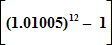
= 12.749%
Illustration 2: APR Computation
Some Competitor Financial Institution. (Illustration Example)
Amount Borrowed£35,000 over 20 Years.
Mortgage Interest Rate Quoted12.06% p.a.
Monthly Repayment Charge£386.85.
Monthly Interest Rate Charged = 1.005%,i.e. 
Giving: APR = 12.749% (as already computed above)
Illustration 3: APR Computation
Some Competitor Financial Institution. (Illustration Example)
Amount Borrowed£35,000 over 20 Years.
Mortgage Interest Rate Quoted11.85% p.a.
Monthly Repayment Charge£381.73.
Monthly Interest Rate Charged = 0.9875%,i.e. 
Giving:APR = 100 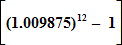
= 12.515%
Comparing the above Illustrations:
| Illustration | Quoted Mortgage Interest Rate | Computed APR | Indicated APR |
| 1 | 11.85% p.a. | 12.749% | 12.7% |
| 2 | 12.06% p.a. | 12.749% | 12.7% |
| 3 | 11.85% p.a. | 12.515% | 12.5% |
From the above Illustrations it is clear that a statement of Annual Percentage Rate (APR) of charge provides the borrower with a statute defined yardstick that enables him to make a true comparison of the ‘cost of credit’ as charged by the various Lending Institutions.
It is also clear that the failure by First National / Irish Life to indicate the APR on their Mortgage Quotation would be likely to mislead a borrower; it would also be likely to afford First National / Irish Life an unfair advantage over a competitor Financial Institution.